

A high school student can do real AI research before college. Not a course, not a camp that ends with a certificate: a project with a question, a method, a result and something to show an admissions reader. This guide covers AI for high school students in the United States and the four ways in, what each one costs in time and money, which university labs actually take high school students, and how to tell a program that produces research from one that produces a receipt.
We have ranked the top AI and robotics labs in American universities before, and the list is still here further down, because knowing where the work happens is part of choosing where to aim. But a ranking of labs is not a route into one. The route is the subject of this article.
What counts as AI research at high school level
AI research for high school students means asking a question that a machine learning model can help answer, testing it on a real dataset, and reporting what you found, including where it fails. In the United States, students do this in summer programs, university labs and mentored projects.
It differs from a class assignment because the answer is not known in advance, and the write-up lets another person repeat the work. Searchers use “machine learning” and “AI” interchangeably, and so does this guide. Machine learning for high school students usually means training a model on training data, then checking the result on data the model has not seen. You do not need Python before you start; Google’s Machine Learning Crash Course is a free place to learn it.
A research project versus a course project
A course project follows instructions toward an answer someone already has. A research project starts with a question nobody handed you, and you choose the data and the method.
What a finished project looks like: question, data, method, result, write-up
A finished project states one question, names its dataset, describes the method, reports the result and its limits, and ends in a write-up. To see what a write-up contains, read a real paper on arXiv’s AI listing.
Four ways into AI research before college
High school students learn AI skills in four ways: summer programs and camps, internships and lab placements, university programs, and mentored independent research. Together they cover the main AI programs for high school students. The first three are selective and seasonal. Mentored independent research starts when the student does.
Summer programs and camps
AI summer programs for high school students run for a few weeks and teach a group together. Some are university-run and selective. An AI summer camp for high school students is usually the paid, open-enrollment kind. For robotics options, see our guide to robotics summer programs for high school students.
University-run programs, selective and often free (MIT Beaver Works, CMU AI Scholars, Stanford AIMI, RSI)
The main free AI programs for high school students are run by universities and research centers. Several are free AI summer programs for high school students, but only for the students they admit. The table gives eligibility and cost for each.
MIT PRIMES: MIT PRIMES is open to students in grades 10 to 12 for most sections. The program is free, and the application deadline is November 2, 2026, at 11:59 PM EST.
MIT Beaver Works Summer Institute: The MIT Beaver Works Summer Institute is open to students entering their senior year. The program costs 0–2,400, depending on the student’s eligibility and program. The application deadline is March 31, 2027.
Carnegie Mellon AI Scholars: Carnegie Mellon AI Scholars is open to rising seniors who are 16 or older and are U.S. citizens or permanent residents. The program is fully funded. The deadline has not yet been officially announced.
Research Science Institute: The Research Science Institute is open exclusively to high school juniors. The program is free, and the application deadline has not yet been officially announced.
The CMU AI Scholars high school summer program is fully funded. Stanford’s AI program for high school students, the Stanford AIMI Summer Research Internship, is covered under internships below. The Harvard AI bootcamp (HUSAI) for high school students is run by a Harvard student group and is a five-day program taught by Harvard undergraduates and graduate-level researchers. AI4ALL is a nonprofit that opens AI education and mentorship to historically excluded talent.
These programs admit a few dozen students a year each and run only in summer. For every student they do not take, the route is a mentored project that starts when the student does.
Paid camps and online programs, and what a certificate is worth
Paid camps and online programs are open to anyone who pays. An AI course for high school students teaches a method, and many AI courses for high school students end in a certificate. A certificate is not research. A tool is not a project; the project is the question you ask with it.
Internships and lab placements
AI internships for high school students place a student inside a working research group. An AI internship for a high school student is usually one task within a larger project. The Stanford AIMI Summer Research Internship is aimed at high school students.
What an AI internship for a high school student looks like in practice
The student takes one task within the lab’s project, and the lab owns the research question.
How to approach a university lab, and what to send
Write to one professor or lab manager. Send a short note with your background, a link to any code or writing you have produced, and the reason you chose that lab. Two of our guides cover this: the reality of cold-emailing university labs and the pros and cons of working in a university lab as a high schooler.
University programs for high school students
University AI programs for high school students are structured offerings from a college, often in summer. Many restrict grade level, age or citizenship, so read the eligibility line first. A high school AI program that fits your grade is worth more than a famous one that does not.
Mentored independent research
Among AI research programs for high school students, mentored independent research pairs a student with a PhD mentor on a project of the student’s own. It does not depend on a cohort or a season.
Which university AI labs take high school students, and which do not
Some university AI labs run programs for pre-college students and some do not. The table below lists eight labs and marks whether each runs anything for pre-college students, with the source for each yes. It is the eight labs with the strongest programs, not a complete list.
Inside eight Research Labs: What They Study and Whether High School Students Can Get Involved
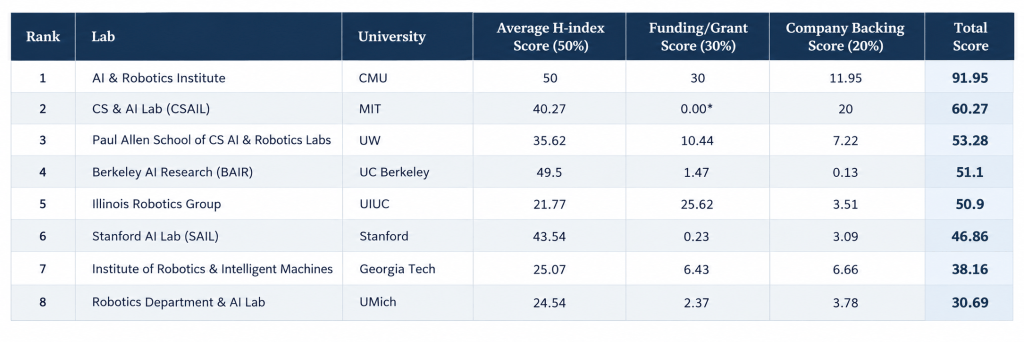
Carnegie Mellon University — AI & Robotics Institute
Carnegie Mellon’s AI and Robotics research spans artificial intelligence, machine learning, autonomous systems, and robotics. For high school students, the AI Scholars program offers a direct pathway into the field: it is a fully funded program designed for rising seniors who are at least 16 years old and are U.S. citizens or permanent residents. Students get exposure to AI research and the broader CMU research environment.
MIT — Computer Science and Artificial Intelligence Laboratory (CSAIL)
MIT’s CSAIL brings together research across artificial intelligence, robotics, computer science, and related fields. High school students can access MIT-connected opportunities such as MIT PRIMES, which provides research experiences for eligible students in grades 10–12, as well as the Beaver Works Summer Institute, an intensive STEM program for students entering their senior year. These programs provide meaningful exposure to advanced computing and AI-related work, although they are not equivalent to joining CSAIL as a research assistant.
University of Washington — Paul G. Allen School of Computer Science & Engineering
The Allen School conducts research across AI, robotics, machine learning, human-computer interaction, and computing. Its Changemakers in Computing program provides a free opportunity for rising juniors and seniors attending Washington State high schools to explore computing and technology. While the program is broader than AI or robotics research specifically, it can provide an accessible entry point for students interested in these fields.
UC Berkeley — Berkeley Artificial Intelligence Research (BAIR)
Berkeley’s BAIR community conducts research across machine learning, computer vision, natural language processing, robotics, planning, and control. Pre-college access has been available through affiliated teen research and STEM programs, including opportunities connected with the Lawrence Hall of Science. Eligibility and program structure can change between cycles, so students should check the current program offerings rather than assuming that BAIR itself accepts high school research interns.
University of Illinois Urbana-Champaign — Illinois Robotics Group
Illinois has extensive research in robotics, intelligent systems, AI, and autonomous technologies. High school students can explore these areas through university-affiliated programs such as the Immersive Intelligence Summer Camp, which combines AI and extended reality (XR) and culminates in a student prototype and certificate. This is best viewed as a structured summer learning experience rather than direct placement in an Illinois robotics research lab.
Stanford University — Stanford AI Lab (SAIL)
Stanford’s AI research ecosystem includes work in machine learning, robotics, computer vision, natural language processing, and other areas of artificial intelligence. High school students may find opportunities through Stanford-affiliated programs such as those offered by the Stanford Center for Artificial Intelligence in Medicine & Imaging (AIMI). These programs can provide research exposure, but students should distinguish between an affiliated pre-college program and direct research access to SAIL.
Georgia Tech — Institute for Robotics & Intelligent Machines (IRIM)
Georgia Tech’s IRIM focuses on robotics and intelligent machines that can perceive, reason, and act, with research spanning areas such as autonomous systems, sensing, and human-robot interaction. High school students can access Georgia Tech’s broader research environment through programs such as the GTRI STEM@GTRI High School Summer Internship, a paid opportunity with specific age, residency, and citizenship requirements. The internship is run through Georgia Tech Research Institute rather than IRIM itself.
University of Michigan — Robotics & AI Research
The University of Michigan has extensive research across robotics, autonomous systems, artificial intelligence, and related engineering fields. For younger students, access is more commonly provided through outreach and educational initiatives than direct lab research. Programs such as robotics workshops for local high school FIRST Robotics teams can give students hands-on exposure, but these should be considered outreach experiences rather than formal research placements in Michigan robotics or AI labs.
Harvard University — Harvard Undergraduate Society for Artificial Intelligence (HUSAI)
Harvard’s undergraduate AI community runs AI Bootcamp, a 5-day intensive program designed for talented high school students. The 2026 program covers machine learning, deep learning, generative AI, NLP, computer vision, reinforcement learning, and AI ethics, culminating in a mini hackathon/research project. The program is taught by Harvard graduate-level researchers and undergraduates and is an affiliated student-led opportunity rather than a direct placement in a Harvard research lab
AI research project ideas a high school student can actually finish
Good AI projects for high school students are small: one question, one public dataset and a result you can check. Good research projects for high schoolers work the same way. They are easiest to finish when the data already exists. Five shapes follow, each with the dataset it would use.
These shapes also serve as AI activities for high school students who are choosing a direction, and as AI research topics for high school students. Use Kaggle Learn for free skills courses and datasets, and Science Buddies’ AI project list, where 25 of 35 projects are marked suitable for high school. For more, see 10 robotics, AI software and embedded systems project ideas.
5 Research Project Models: What You’d Study and What Dataset You’d Need
Image classification (computer vision). Train a model to sort images into categories and test it on unseen images. Dataset: a public image dataset on Kaggle.
Text classification (natural language processing). Train a model to label text by topic or tone. Dataset: a public text dataset on Kaggle.
Prediction from tabular data. Predict a numeric outcome from other measurements. Dataset: a public environmental or health table on Kaggle.
Reproducing a published result. Rebuild a short arXiv paper’s method on a smaller dataset and report whether the result holds. Dataset: the one the paper uses, or a subset.
Reinforcement learning in simulation. Teach an agent a control task in a free simulator and measure how fast it learns. Dataset: none; the simulator generates the data.
How to choose a program, and what to avoid
Choose the program that gives you a question of your own, a named mentor and finished work at the end. If you are eligible for a free university-run program, apply. If you are not admitted or not eligible, a mentored project is the route that does not depend on a seat. Avoid any program that cannot name your supervisor.
Five questions to ask before paying anyone
- Who, by name, will supervise my work?
- Will I choose my own question?
- What will I have at the end to show?
- How many hours of one-to-one mentoring are included?
- What happens if my approach fails?
Free versus paid: what the fee buys and what it does not
A fee can buy structure and mentor time. It does not buy admission to a university lab. Judge a program by the five questions, not the price.
Questions parents and students ask
A high school student can do AI research for free or for a fee. MIT PRIMES and the Research Science Institute are free, and Carnegie Mellon AI Scholars is fully funded, but each admits only a few dozen students a year. For everyone else, the route is a mentored project that starts when the student does.
Can a high school student publish AI research? Yes. Students can enter competitions such as Regeneron ISEF and the Junior Science and Humanities Symposium, or write up the project and post it to arXiv. A finished, documented project has value even if it is never published.
How much does an AI research program cost? It varies by program. MIT PRIMES and the Research Science Institute are free, and Carnegie Mellon AI Scholars is fully funded. The Stanford AIMI page does not state a cost. For a paid program, ask what the fee covers.
Do I need to know Python first? No. Students can learn Python alongside a first project with free resources such as Kaggle Learn and Google’s Machine Learning Crash Course.
Does AI research help with college admissions? A real project gives an admissions reader something concrete to read: a question, a method and a result. It helps most when you can explain it in your own words.
What is the difference between an AI internship and an AI research program? An internship places you inside someone else’s project, usually on a narrow task. A research program gives you a question of your own and a mentor.
Where to start this month
Start with one project shape from the list above, one public dataset, and one lab or mentor to write to. Keep the first month small. The aim is a question you can state in one sentence and a dataset you can open, not a finished project.
A competition can give that project a deadline and an audience. For AI competitions for high school students, our Regeneron ISEF guide for high school students explains how that route works, and our Junior Science and Humanities Symposium guide covers the second. Read them once you have a question and a dataset, so you can see which route fits your project.
This month, finish a free course on Kaggle Learn to pick up the Python and data skills a first project needs. Read one paper on arXiv to see what a write-up contains. Then write down your question, your dataset and how you will check the result, and send your note to one lab or mentor.
When you want the details from the source, the Regeneron International Science and Engineering Fair page from Society for Science explains that finalists qualify by winning at a Society-affiliated local, regional, state or national science fair. The Junior Science and Humanities Symposium site describes a competition that challenges high school students and builds skills for college and career.
👉 A mentored research project can have add significant value to your student’s profile and portfolio for college. Start your application below.


